

The Essential Guide to the Role of Cognitive Exercises

Over 70 percent of american adults report at least some concern about age related memory loss, making brain health a top priority for many. As people grow older, staying mentally sharp becomes just as important as staying physically healthy. Understanding what cognitive exercises are, how they work, and why they matter can help anyone build a stronger, more resilient mind at every stage of life.
Table of Contents
- Defining Cognitive Exercises And Key Concepts
- Major Types Of Cognitive Exercises Explained
- How Cognitive Training Benefits Brain Health
- Integrating Cognitive Workouts Into Daily Life
- Risks, Limitations, And What To Avoid
Key Takeaways
| Point | Details |
|---|---|
| Cognitive exercises enhance brain function | Structured mental activities aim to improve memory, processing speed, and executive function across various cognitive domains. |
| Variety is crucial for effectiveness | Engaging in diverse and challenging cognitive tasks helps maintain mental resilience and prevent skill stagnation. |
| Regular practice is essential | Consistent cognitive training over time can slow age-related cognitive decline and support overall brain health. |
| Individual needs matter | Tailoring cognitive exercises to personal abilities and preferences maximizes benefits while avoiding frustration from overly difficult tasks. |
Defining Cognitive Exercises and Key Concepts
Cognitive exercises represent structured mental activities designed to challenge, stimulate, and enhance brain function across multiple domains. According to the University of North Texas Health Science Center, cognitive training involves specialized programs aimed at teaching strategies and providing guided practice for improving specific mental capabilities like memory processing and cognitive speed.
Cognitive exercises are not just random mental tasks but carefully crafted interventions targeting different areas of brain performance. These activities range from memory games and puzzle solving to learning new skills and engaging in complex problem solving. The primary goal is to maintain mental agility, potentially slow cognitive decline, and support overall brain health as individuals age.
Key components of effective cognitive exercises include:
- Novelty: Introducing new challenges that push mental boundaries
- Complexity: Tasks that require multiple cognitive processes simultaneously
- Engagement: Activities that are interesting and motivational
- Consistency: Regular practice to reinforce neural connections
While research from unthsc.edu suggests that training on specific cognitive skills may enhance those particular abilities, evidence remains limited regarding broad improvements across all cognitive domains. This underscores the importance of diverse, well-rounded cognitive training approaches that challenge multiple mental functions.
Major Types of Cognitive Exercises Explained
Memory training exercises represent a fundamental category of cognitive interventions designed to enhance information retention and recall abilities. National Institutes of Health research demonstrates that comprehensive cognitive training programs can effectively improve multiple cognitive capacities through targeted memory enhancement techniques like memorization games, sequence recall challenges, and spatial memory tasks.
Executive function exercises focus on improving higher order cognitive skills such as planning, decision making, problem solving, and mental flexibility. These activities typically involve complex tasks that require multistep reasoning, strategic thinking, and rapid mental adaptations. Classic examples include chess, advanced puzzle solving, and scenario based reasoning challenges that push individuals to think critically and make quick mental adjustments.
Another critical category includes processing speed and attention exercises, which aim to sharpen mental reaction times and concentration capabilities. According to Brain Sciences research, cognitive training interventions can significantly enhance executive function and cognitive performance across different populations by systematically challenging mental processing speed and sustained attention.
The primary categories of cognitive exercises can be summarized as:
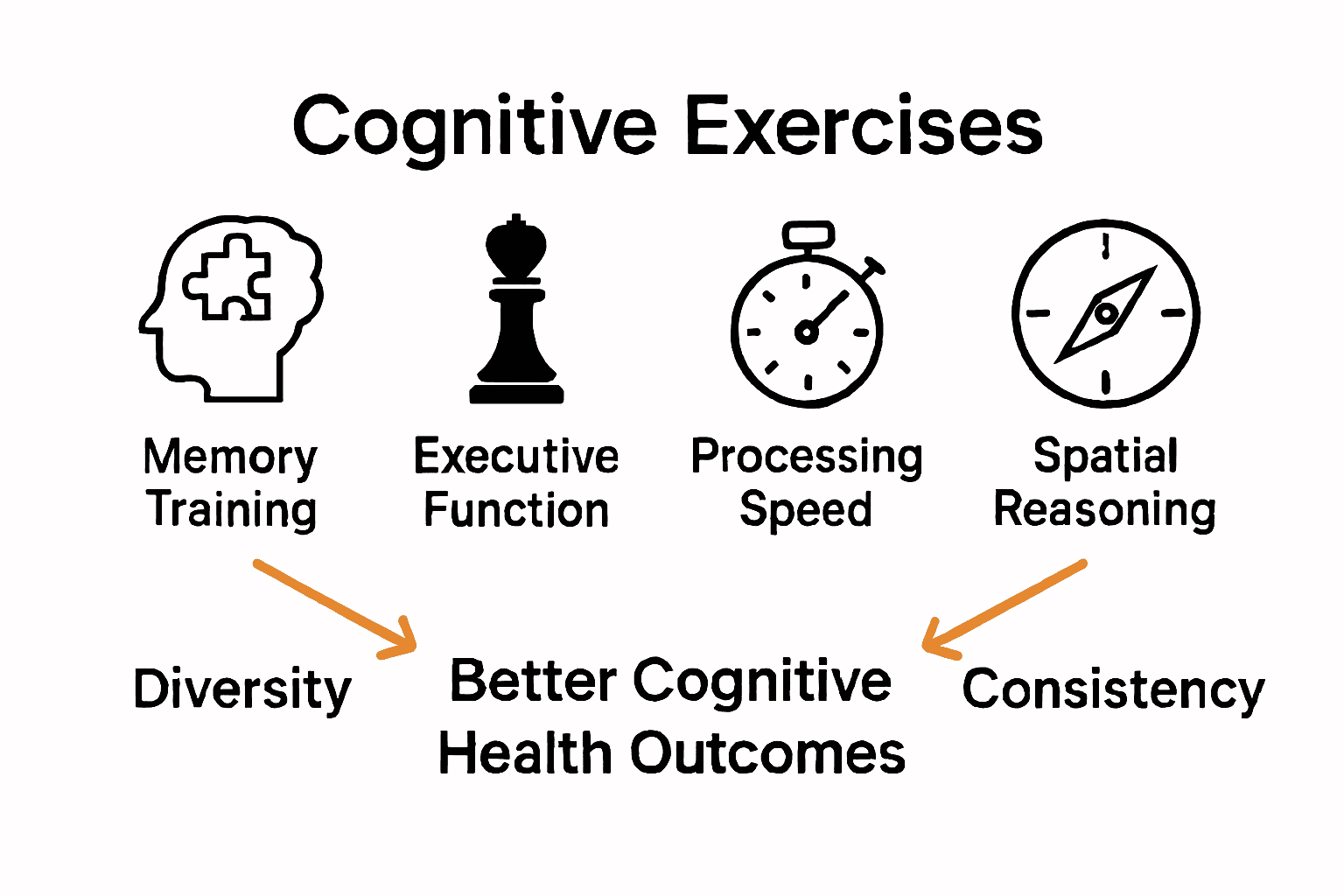
- Memory Training: Sequential recall, pattern recognition
- Executive Function: Strategic problem solving, multitask challenges
- Processing Speed: Rapid response activities, concentration tasks
- Spatial Reasoning: Navigation and visual manipulation exercises
These diverse exercise types work synergistically to maintain cognitive resilience, potentially slowing age related mental decline and supporting overall brain health for adults seeking proactive mental fitness strategies.

How Cognitive Training Benefits Brain Health
Cognitive training offers substantial benefits for brain health, with research demonstrating its powerful potential to maintain and enhance mental capabilities as we age. British Journal of Sports Medicine research confirms that targeted exercises can significantly improve general cognition, memory, and executive function across different population groups, providing a compelling argument for proactive mental fitness strategies.
For adults over 40, cognitive training becomes increasingly crucial in preserving mental agility and potentially mitigating age-related cognitive decline. Journal of the American Geriatrics Society meta-analysis reveals moderate yet meaningful improvements in cognitive function, particularly in areas like memory, attention, and visual-spatial abilities. These findings underscore the importance of consistent mental exercise as a preventative approach to neurological health.
The primary mechanisms through which cognitive training benefits brain health include:
- Neuroplasticity Enhancement: Stimulating brain’s ability to form new neural connections
- Cognitive Reserve Building: Creating mental resilience against potential future decline
- Mental Flexibility Improvement: Maintaining adaptability in thinking and problem solving
- Stress Reduction: Providing structured mental engagement that reduces cognitive anxiety
Regular cognitive training acts like a comprehensive workout for the brain, challenging mental processes and potentially slowing age-related cognitive changes. By systematically engaging different cognitive domains, individuals can maintain mental sharpness, support overall brain health, and enjoy enhanced cognitive performance well into later life.
For those interested in supporting their brain health through nutrition, check out our brain health foods guide for Canadians over 40.
Integrating Cognitive Workouts Into Daily Life
Transforming cognitive exercises from occasional activities to consistent daily practices requires strategic planning and creative integration. International Journal of Environmental Research and Public Health research highlights the significant potential of incorporating cognitively engaging activities into routine schedules, demonstrating that even short mental challenges can substantially improve cognitive performance.
Practical strategies for embedding cognitive workouts into everyday life involve identifying natural opportunities for mental stimulation. These can range from mindful morning puzzles during breakfast to strategic problem solving during commute times. BMC Public Health studies suggest that structured yet flexible cognitive engagement approaches can dramatically enhance mental agility and overall cognitive functioning.
Effective cognitive workout integration strategies include:
- Morning Brain Activation: Solving crossword or Sudoku puzzles
- Commute Cognitive Challenges: Mental math or memory recall games
- Technology-Assisted Training: Brain training apps during idle moments
- Social Cognitive Interactions: Strategic board games or group problem solving
Consistent cognitive exercise does not require extensive time commitments. Even 15-20 minutes of focused mental engagement daily can yield significant neurological benefits. For those seeking to develop comprehensive wellness routines, our guide to healthy routines for adults 40+ provides additional insights into maintaining holistic mental and physical health.
Risks, Limitations, and What to Avoid
Cognitive training, while beneficial, is not a universal solution for brain health and requires a nuanced approach. Global Council on Brain Health research reveals that training focused on specific cognitive abilities may improve those particular skills, but evidence remains limited regarding broader cognitive enhancement or direct translation to everyday functional performance.
Potential risks in cognitive training emerge when individuals adopt overly narrow or repetitive approaches. Cognitive exercises should challenge the brain dynamically, avoiding monotonous routines that could lead to skill stagnation. Overreliance on single types of exercises might create artificial cognitive improvements that do not generalize to real-world problem solving or adaptive thinking requirements.
Key limitations and potential pitfalls to be aware of include:
- Skill Specificity: Improvements might not transfer across different cognitive domains
- False Sense of Protection: Cognitive exercises are not a guaranteed defense against age-related decline
- Psychological Stress: Overly challenging exercises might create performance anxiety
- Individual Variation: Cognitive training effectiveness varies significantly between individuals
To maximize cognitive training benefits, adults should prioritize diverse, engaging, and professionally guided approaches that respect individual cognitive differences. Consulting healthcare professionals can help develop personalized cognitive exercise strategies tailored to specific needs and potential limitations.
Empower Your Brain Health with Targeted Wellness Solutions
The Essential Guide to the Role of Cognitive Exercises reveals the critical need for novel, engaging, and consistent mental workouts to maintain brain agility and slow age-related decline. If you are seeking practical ways to boost your memory, executive function, or processing speed, tackling this challenge goes beyond exercises alone. You need a comprehensive approach that supports neuroplasticity and cognitive reserve while fitting seamlessly into your daily life.

Discover how you can enhance your cognitive training routine with specialized products designed for adults over 40 at Real Healthy Haven. From comfortable activewear for mindful movement to health monitors that track your wellness progress, our curated selection helps you stay motivated and consistent. Explore our wellness supplements, therapeutic supplies, and fitness gear that align with the concepts of engagement and brain health promotion explained in the article. Take charge of your mental fitness journey today by visiting Real Healthy Haven and start integrating effective cognitive workouts with the right tools and resources. Your brain deserves the best support possible right now.
Frequently Asked Questions
What are cognitive exercises?
Cognitive exercises are structured mental activities designed to challenge and enhance brain function. They include memory games, puzzle solving, and tasks that engage various cognitive processes.
How do cognitive exercises benefit brain health?
Cognitive exercises can improve general cognition, memory, and executive function, especially in adults over 40. They enhance neuroplasticity, build cognitive reserve, and reduce stress, promoting overall mental agility.
What types of cognitive exercises should I incorporate into my routine?
Consider including memory training, executive function tasks, processing speed drills, and spatial reasoning activities to create a well-rounded cognitive training regimen that challenges your mind effectively.
Are there any risks associated with cognitive training?
Yes, potential risks include skill specificity, false sense of protection against cognitive decline, and individual variability in effectiveness. It’s important to avoid monotonous practices and consult professionals for tailored strategies.
Leave a comment